Data Center Roofing
A roof leak in a data center isn't a maintenance issue — it's a $2M insurance claim waiting to happen. JRH serves DFW data centers with zero-downtime installation, thermal imaging inspections, and systems built for the I-35 corridor's most demanding facilities. Call Landry to schedule a site assessment.
- GAF Master Elite (top 2%)
- BBB A+ accredited since 2019
- 7+ years in business
- 5★ from 12+ Google reviews
- 600+ DFW roofs replaced
- Family-owned & operated
- GAF Master Elite Certified — top 2% of roofers nationally
- BBB A+ Accredited
- 7+ Years in Business
- 5-Star Rated on Google
- 600+ DFW Roofs Replaced
- Family-Owned & Operated
Data Center Roofing in Dallas-Fort Worth
Here's what most facility managers don't know until it's too late: data center roofs fail quietly. A pinhole in a heat-welded seam. A flashing that was installed correctly but pulled away from a cable tray penetration over two summers of thermal cycling. A drainage slope that was fine when the building was new but now holds 8 inches of standing water after every North Texas thunderstorm. None of these are visible from the ground. None show up in an annual inspection by a general roofer. They show up in the server room. JRH's thermal imaging scans catch all three — before the leak.
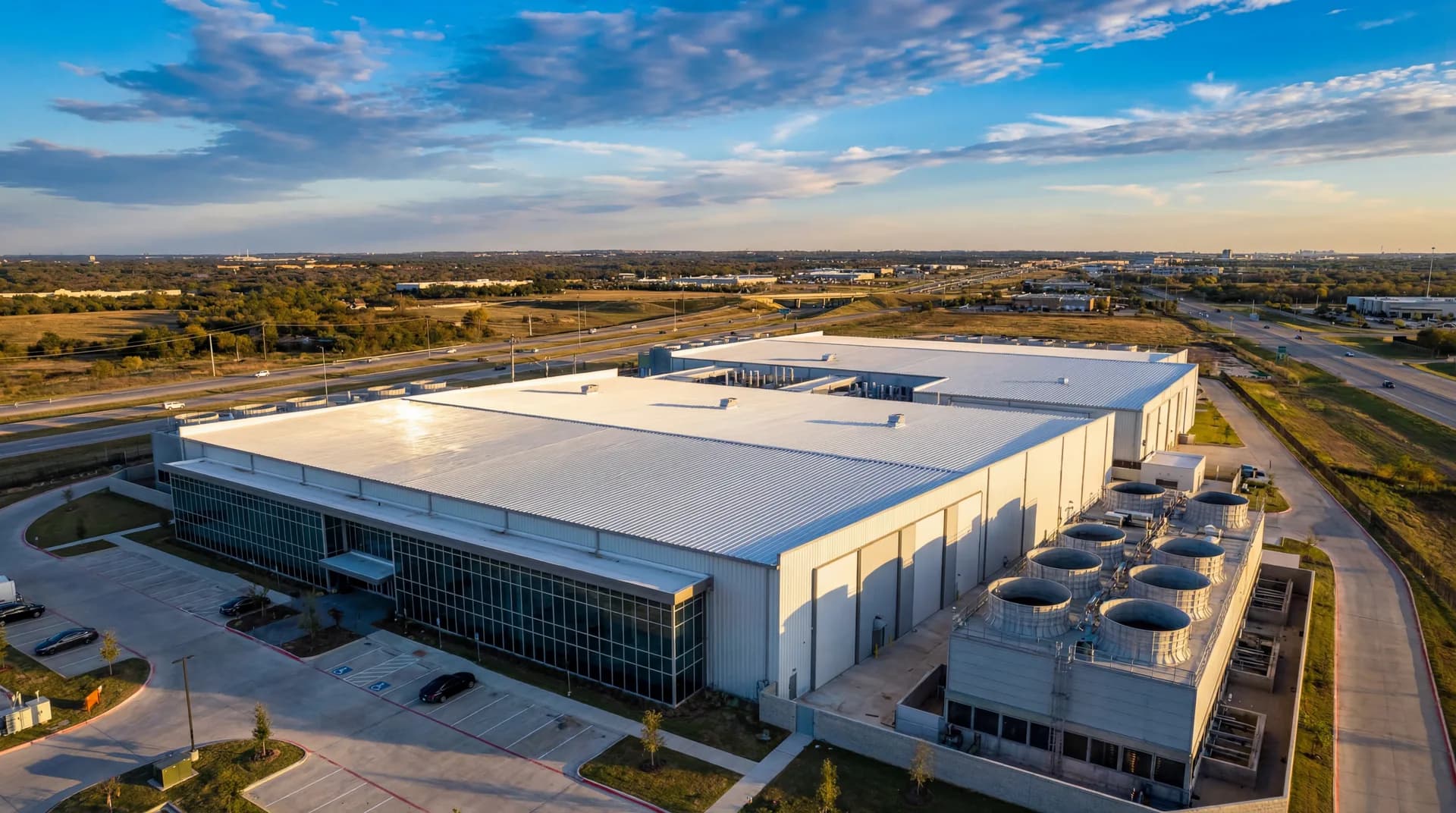
Dallas-Fort Worth is the largest data center market in the United States. Google has committed $1B+ to its DFW campus. Meta, Microsoft Azure, Oracle, and Flexential have built major facilities along the I-35 corridor. Over 2,500 megawatts of operational capacity, 1,000+ more under construction. Behind every one of those buildings is a roof — and a question of who's responsible for it when something goes wrong. JRH serves the DFW data center market specifically: security protocols, documentation standards, phased installation that doesn't touch uptime, and crews who've been on these job sites before.
Data center roofing isn't standard commercial roofing with extra steps. The mechanical equipment density alone is a different engineering problem: HVAC units, cooling towers, cable trays, generators, antenna arrays — every one of them is a penetration, and every penetration is a potential leak point. Joel's crew designs custom flashing details for each one, photographs every installation, and keeps documentation that satisfies insurance carriers, Tier certification auditors, and tenant due diligence requirements. This level of documentation is standard for JRH on every data center job. It's not something you have to request.
The system selection matters as much as the installation. For most DFW data centers, 80-mil or 90-mil TPO is the right call: reflective surface reduces cooling loads by up to 30%, heat-welded seams hold, and the manufacturer warranties are 20-30 years. For Tier III and Tier IV facilities with chemical exposure risk from rooftop cooling equipment, PVC makes more sense. For re-roofs where minimizing construction time is the priority, spray polyurethane foam eliminates the tear-off entirely. Jonathan can walk through the tradeoffs with your facility engineer — or just tell you what he'd install if it were his building.
The I-35 corridor from Carrollton through Lewisville to Denton is the highest concentration of data center construction in Texas. The Telecom Corridor in Richardson and Plano, the Allen and Garland builds along Highway 75, the newer facilities in Lancaster and Grand Prairie — JRH has crews active in all of these submarkets. The company is structured for rapid response: maintenance clients get a 4-hour guaranteed on-site arrival for any leak event. Not a callback. Not a scheduled assessment. Someone on-site in 4 hours.
Preventive maintenance is where the real risk management happens. A biannual inspection with thermal imaging catches the moisture infiltration that an annual visual inspection misses. Seam integrity testing identifies the sections approaching end of life before they fail. Drainage audits prevent the standing water that accelerates membrane degradation by years. JRH's maintenance program clients have documentation trails that satisfy FM Global, insurance carriers, and SSAE 18 auditors. Ask Landry what the program looks like for a facility your size.
Why Data Centers Need Specialized Roofing
A standard commercial roofer sees a flat roof. Joel's crew sees a thermal envelope sitting on top of $50 million in servers. One leak, one seam failure, one penetration that wasn't flashed right — that's a very different kind of problem than a wet ceiling.
Thermal Performance
Data centers generate immense internal heat loads. A properly specified cool roof membrane reduces solar heat gain by up to 30%, directly lowering the energy required by HVAC and cooling systems to maintain optimal server operating temperatures between 64-80 degrees F.
Zero-Leak Guarantee
A single roof leak in a data center can destroy millions of dollars in server equipment, trigger SLA violations, and compromise data integrity. JRH installs fully adhered membrane systems with heat-welded seams, redundant flashing at every penetration, and manufacturer-backed leak-free warranties.
Redundancy Engineering
Just as data centers build N+1 redundancy into power and cooling systems, your roofing system should provide redundant waterproofing protection. Multi-layer modified bitumen, dual-membrane TPO configurations, and fully adhered systems eliminate single points of failure in the building envelope.
Minimal Downtime Installation
JRH uses phased, zone-by-zone installation that never compromises the waterproofing integrity of adjacent sections. Temporary barriers and emergency tarping protocols are maintained at all times. No client facility has ever experienced downtime during a JRH roof installation.
Mechanical Equipment Density
Data center roofs support dozens of HVAC units, cooling towers, generators, cable trays, and antenna arrays. Each penetration is a potential leak point. JRH designs and installs custom flashing details for every rooftop penetration, with photographic documentation of each installation.
Preventive Maintenance Programs
Biannual inspections, infrared thermal imaging, seam integrity testing, and drainage system audits ensure your roof maintains peak performance between installation and end-of-warranty. Maintenance clients receive 4-hour guaranteed emergency response for any leak event.
Data Center Roofing Systems We Install
Every system is selected for performance in mission-critical environments — engineered for thermal efficiency, waterproofing redundancy, and long-term reliability in the DFW climate.
TPO (Thermoplastic Polyolefin)
The most widely specified membrane for DFW data centers. White reflective surface reduces cooling loads by up to 30%. Heat-welded seams create monolithic waterproofing. Available in 60-mil, 80-mil, and 90-mil thicknesses for varying performance tiers. 20-30 year manufacturer warranties from GAF, Carlisle, and Firestone.
PVC (Polyvinyl Chloride)
Premium single-ply membrane with superior chemical resistance -- critical for facilities where rooftop mechanical equipment may discharge coolants or cleaning agents. Hot-air welded seams strengthen over time. Excellent fire resistance ratings. Preferred by Tier III and Tier IV facilities requiring maximum reliability.
Modified Bitumen
Multi-layer built-up system providing redundant waterproofing through overlapping plies. Self-healing properties in DFW summer heat. Ideal for roofs with heavy foot traffic from mechanical maintenance access. Available with reflective cap sheets for energy efficiency. 20+ year proven performance in Texas climates.
Reflective Cool Roofing Systems
ENERGY STAR-rated coatings and membranes that reflect up to 90% of solar radiation. In the DFW climate where summer roof surface temperatures can exceed 170 degrees F, cool roofing systems measurably reduce the cooling energy required to maintain server room temperatures. ROI typically realized within 3-5 years through HVAC energy savings alone.
Spray Polyurethane Foam (SPF)
Seamless, self-adhering insulation and waterproofing system applied directly to existing substrates. Eliminates all seams and fastener penetrations. R-value of 6.5 per inch provides exceptional thermal performance. Ideal for re-roofing projects where minimizing construction duration is paramount.
Tapered Insulation Systems
Engineered polyisocyanurate insulation boards cut to precise slopes that eliminate ponding water -- the leading cause of premature membrane failure. Custom-designed drainage plans for each facility ensure zero standing water within 48 hours of rainfall, meeting FM Global and insurance carrier requirements.
Data Center Facilities We Serve
Joel's crew has worked on everything from massive hyperscale builds along I-35 to smaller edge facilities tucked into industrial parks in Garland and Grand Prairie. The scale changes. The waterproofing standard doesn't.
The DFW Data Center Landscape
The Dallas-Fort Worth metroplex is the largest data center market in the United States, surpassing Northern Virginia in total pipeline capacity. Google's $1 billion investment in DFW data center infrastructure underscores what the industry already knows: the combination of low energy costs, central geographic location, favorable tax environment, robust fiber connectivity, and a business-friendly regulatory climate makes DFW the premier location for hyperscale and enterprise data center deployment in North America.
The I-35 corridor from Carrollton through Lewisville to Denton hosts the densest concentration of data center construction in the region. The Telecom Corridor in Richardson and Plano continues to attract colocation and enterprise facilities. Allen, Garland, and the Highway 75 corridor are emerging markets for new builds. South of Dallas, Lancaster, DeSoto, and Grand Prairie are seeing accelerated development driven by available power capacity and competitive land costs. JRH Construction actively serves every one of these data center submarkets with dedicated crews and project managers.
As DFW keeps building, the demand for roofing contractors who actually understand mission-critical environments — not just flat roofing in general — keeps growing too. JRH has the bonding capacity, the manufacturer certifications, the security protocol compliance, and the crews who know what they're walking onto when they show up to a data center site. Joel started this company. Landry and Jonathan run the day-to-day. They pick up when you call.
Protect Your Mission-Critical Infrastructure
New build, re-roof, or you just want someone to walk the facility and tell you what's actually going on up there — call Landry or Jonathan. They'll get you scheduled and give you a straight answer on what it takes.
$10M+ bonding capacity • GAF Master Elite • Owens Corning Platinum Preferred
Data Center Roofing Questions
Questions Joel's team gets from facility managers, GCs, and owners before they pull the trigger on a data center roofing project in DFW.
JRH Construction uses a phased installation methodology specifically developed for mission-critical facilities. We divide the roof into zones and complete each zone independently, maintaining full waterproofing integrity on all adjacent zones at all times. Work is scheduled during approved maintenance windows when possible. We deploy temporary waterproofing barriers at all active work boundaries and maintain emergency tarping materials on-site throughout the project. No data center client of JRH has ever experienced downtime attributable to our roofing work.
Related Articles
Expert roofing advice, pricing guides, and tips for Dallas-Fort Worth property owners.
Explore Our Other Services

Ready to Discuss Your Data Center Project?
Call us directly or fill out our online form for a free, no-obligation assessment of your data center roofing needs. Family-owned. Veteran-operated.